
The ongoing conflict involving Iran is no longer just a geopolitical flashpoint it is rapidly becoming a major economic threat with global consequences. According to the Organisation for Economic Co-operation and Development (OECD), a prolonged war scenario could push U.S. inflation above 4% in 2026, significantly higher than earlier projections and well above the Federal Reserve’s target of 2%.
The warning underscores a growing concern among economists and policymakers that geopolitical instability in the Middle East could trigger a sustained period of elevated inflation, slow growth and complicating monetary policy decisions worldwide.
A Sharp Revision in Inflation Outlook
In its latest economic outlook, the OECD revised its U.S. inflation forecast upward to approximately 4.2% for 2026. This represents a notable increase from previous estimates, which had placed inflation closer to 3%. The upward revision reflects the economic fallout from the ongoing conflict, particularly its impact on global energy markets.
The United States, while less dependent on imported oil than many countries, is still deeply integrated into global energy pricing systems. As a result, any significant disruption in oil supply, especially from a critical region like the Middle East, quickly feeds into domestic prices.
The OECD’s projection assumes a continuation of current tensions. Should the conflict escalate further or lead to prolonged disruptions in supply chains, inflation could rise even higher.
The Central Role of Energy Prices
At the heart of the inflation surge is a familiar driver: oil. The Middle East remains one of the most important oil-producing regions in the world, and any instability there has immediate repercussions for global supply.
A key chokepoint is the Strait of Hormuz, through which roughly 20% of the world’s oil supply passes. Any disruption, whether due to military activity, blockades, or heightened risk premiums, can send oil prices soaring.
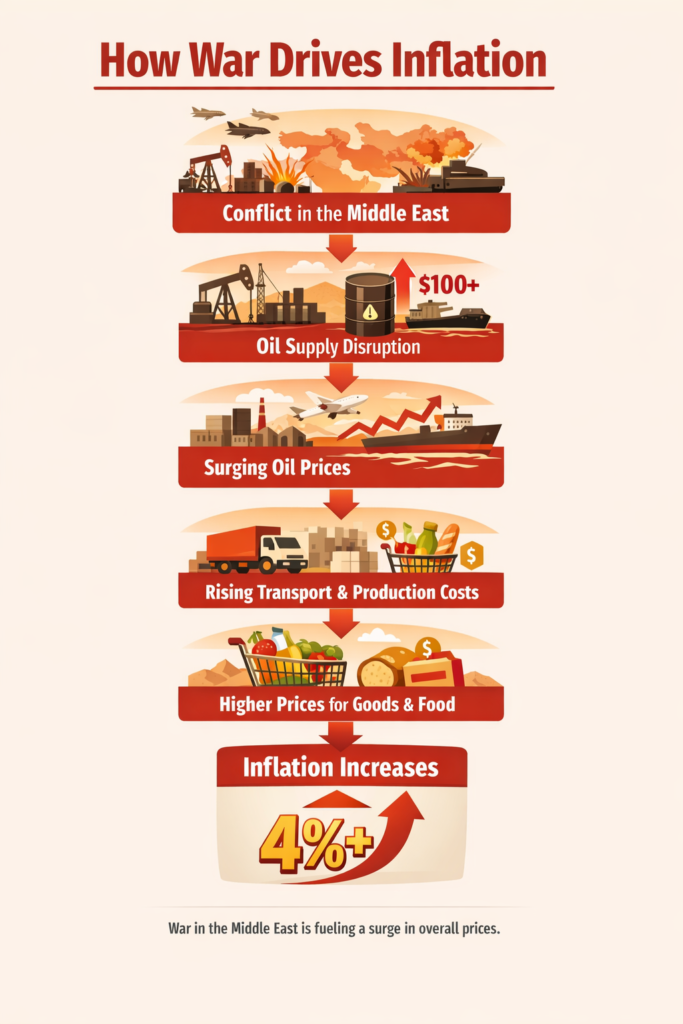
In recent weeks, crude oil prices have surged past the $100 per barrel mark, with some analysts warning they could climb even higher if tensions persist. Higher oil prices translate directly into increased costs for gasoline, diesel, and jet fuel, affecting everything from daily commutes to global trade.
How Energy Costs Fuel Broader Inflation
The impact of rising energy prices does not stop at the fuel pump. Instead, it spreads across the entire economy in what economists call “cost-push inflation.”
Transportation costs increase as fuel becomes more expensive, raising the price of goods shipped by road, air, and sea. Manufacturers face higher input costs, particularly in energy-intensive industries such as chemicals, metals, and agriculture. Farmers, in turn, pay more for fuel and fertilizers, pushing up food prices.
This ripple effect means that even sectors not directly tied to energy still experience price increases. Over time, these cost pressures can become embedded in the broader economy, leading to sustained inflation rather than a temporary spike.
Supply Chain Disruptions Add to Pressure
Beyond energy, the conflict is also disrupting global supply chains. The Middle East plays a crucial role not only in oil production but also in the movement of goods between Asia, Europe, and Africa.
Shipping routes have become more volatile, insurance costs for cargo have risen, and delays are becoming more common. These disruptions add another layer of cost, further fueling inflationary pressures.
In a globalized economy, such disruptions rarely remain localized. Instead, they cascade through international trade networks, affecting production timelines and increasing prices worldwide.
A Challenge for the Federal Reserve
Rising inflation presents a significant dilemma for the Federal Reserve. The central bank has spent years attempting to bring inflation down to its 2% target, using interest rate hikes as its primary tool.
However, inflation driven by external shocks such as war and energy price spikes is much harder to control. Raising interest rates can dampen demand, but it does little to address supply-side constraints like reduced oil output or disrupted shipping routes.
If inflation climbs above 4%, the Federal Reserve may be forced to keep interest rates higher for longer, potentially slowing economic growth and increasing the risk of recession.
Global Spillover Effects
The implications of the conflict extend far beyond the United States. The OECD has also warned that global inflation is likely to remain elevated, with G20 economies facing similar pressures.
For emerging markets, the situation can be even more challenging. Higher energy prices can weaken currencies, increase import bills, and strain government budgets. Countries that rely heavily on imported oil are particularly vulnerable.
Even advanced economies in Europe and Asia are not immune. Many are more dependent on Middle Eastern energy supplies than the U.S., making them highly sensitive to disruptions.
Persistent Inflation Risks
One of the most concerning aspects of the current situation is the risk that inflation could remain elevated for an extended period. Even if the conflict de-escalates, its economic effects may linger.
Energy infrastructure may take time to repair, supply chains may require restructuring, and businesses may continue to factor geopolitical risk into pricing decisions. These factors can keep inflation above target levels long after the immediate crisis has passed.
This persistence poses a challenge for policymakers, who must balance the need to control inflation with the risk of stifling economic growth.
What Lies Ahead
The trajectory of inflation will depend largely on how the conflict evolves. A rapid de-escalation could stabilize energy markets and ease inflationary pressures. However, a prolonged or escalating war would likely push inflation even higher, reinforcing the OECD’s warnings.
For now, the outlook remains uncertain. What is clear, however, is that geopolitical events are once again playing a central role in shaping economic outcomes.
Conclusion
The OECD’s warning that continued war with Iran could push U.S. inflation above 4% highlights the deep interconnection between geopolitics and economics. Rising energy prices, disrupted supply chains, and global uncertainty are combining to create a challenging environment for policymakers and consumers alike.
As the situation unfolds, the world will be watching not only the geopolitical developments but also their economic consequences. For the United States and the global economy, the stakes are high and the path forward remains uncertain.
Leave a Reply