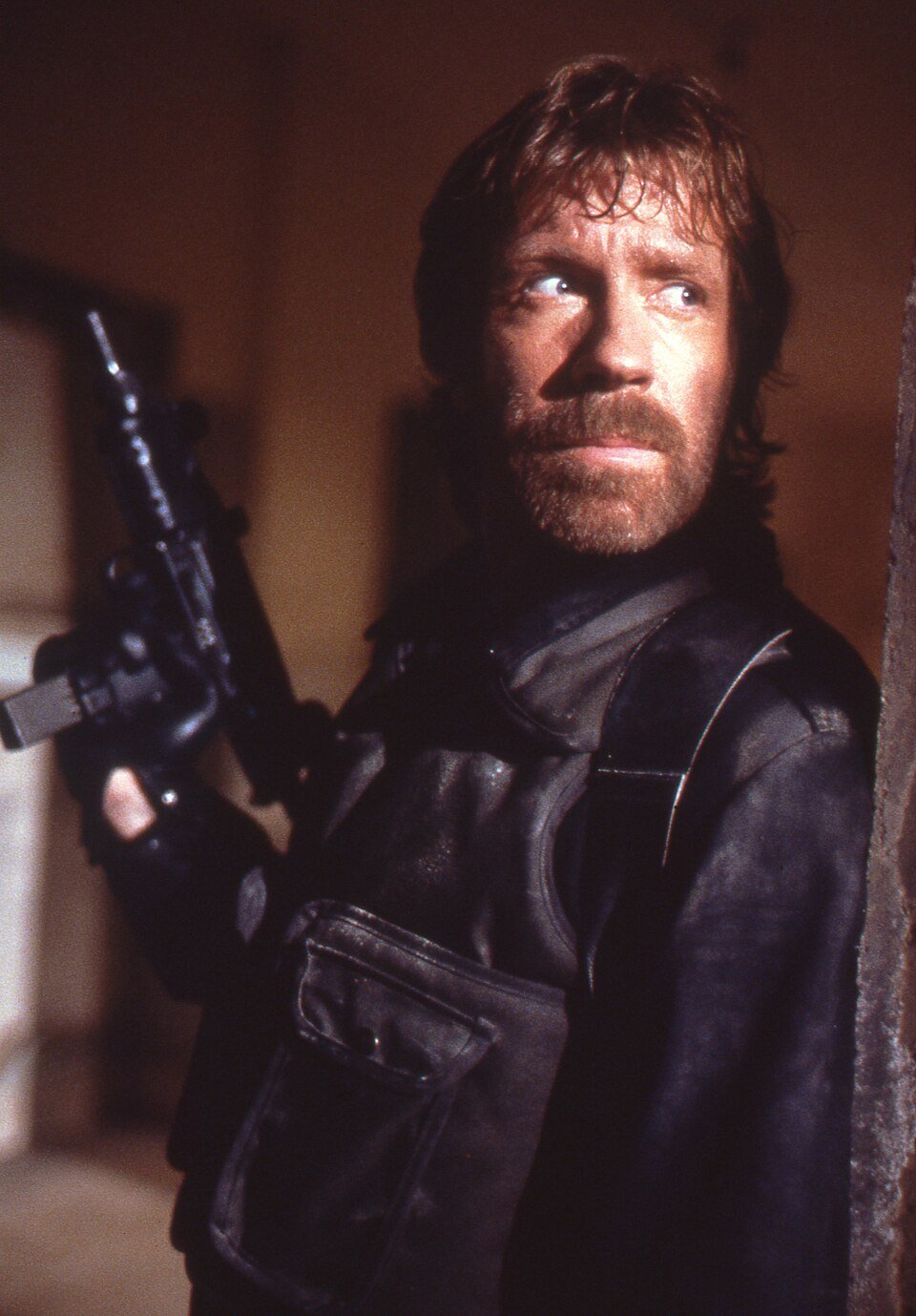
Chuck Norris was one of the most recognizable action stars of the late twentieth century, a figure whose presence defined an entire era of film and television. With his martial arts background, calm confidence, and unmistakable screen persona, he came to represent a distinctly American kind of hero. His characters were strong without being flashy, disciplined without being distant, and always guided by a clear sense of right and wrong. For many audiences, Norris was not just another action star. He was a symbol of strength, order, and moral certainty.
From Martial Arts to Mainstream Stardom
His rise to fame began in the 1970s, when martial arts films were gaining popularity worldwide. Norris first appeared on the big screen in a memorable role opposite Bruce Lee in The Way of the Dragon. Although he played the antagonist, the performance left a lasting impression and opened the door to a series of leading roles. By the time he starred in Good Guys Wear Black, he had established himself as a leading man capable of carrying a film through physical presence and quiet charisma alone.
The Formula Behind Norris’ Success
Throughout the late 1970s and 1980s, Norris developed a consistent on screen identity. He often portrayed characters with military or law enforcement backgrounds, individuals who operated on the edge of official systems but always believed in justice. These roles placed him in situations where the world around him was unstable or corrupt, and only decisive action could restore balance. Whether he was rescuing prisoners of war, confronting drug cartels, or stopping acts of terrorism, the narrative structure remained familiar. A lone man stands against chaos, relies on his skills and convictions, and ultimately prevails.
This formula proved incredibly successful. It resonated with audiences who were drawn to stories of individual heroism and clear moral boundaries. In a time when global politics and social tensions were often complicated and uncertain, Norris offered something simple and reassuring. His characters did not hesitate or second guess themselves. They acted with certainty, and that certainty was framed as strength.
Shaping the Action Genre
The influence of these films extended beyond Norris himself. The broader action genre began to adopt similar themes and structures, emphasizing spectacle, firepower, and national pride. Stories shifted away from introspection and toward external conflict, where enemies were clearly defined and victory was achieved through force. Norris was not the only actor contributing to this shift, but he was one of its most consistent representatives. His films helped solidify a vision of the action hero as a figure who could solve problems alone, often through violence, and without the need for institutional approval.
In many of his most popular films, the settings reinforced this idea. Norris would frequently operate in foreign environments or unfamiliar territories, places depicted as dangerous or morally compromised. His presence in these spaces symbolized a form of intervention, where an American figure restored order through strength and determination. Even when the story took place within the United States, the narrative often framed the community as under threat from external forces, requiring a strong individual to defend it.
From Film to Television: Walker, Texas Ranger
This pattern carried into the next phase of his career when he transitioned to television with Walker, Texas Ranger. The series brought his established persona into a weekly format and reached a broader audience. As Cordell Walker, Norris played a Texas Ranger who upheld justice with unwavering conviction. The show presented a world where good and evil were clearly separated, and where the hero always acted correctly, even when bending or bypassing formal procedures.
Walker, Texas Ranger became a cultural touchstone in the 1990s, partly because of its simplicity. It offered viewers a sense of comfort in its predictability. Each episode followed a structure in which wrongdoing was identified, confronted, and resolved. The moral clarity of the series made it accessible and appealing, especially in contrast to more complex or ambiguous storytelling emerging at the time.
The Politics of Strength and Justice
However, it is this very clarity that invites deeper examination. The world portrayed in Norris films and television work often reduces complicated issues to straightforward conflicts. There is little room for ambiguity, nuance, or competing perspectives. The hero knows what is right, and the narrative supports that belief without question. This approach can be satisfying in fiction, but it also raises questions about the messages being conveyed.

One of the central concerns is the portrayal of justice. In many of Norris roles, legal systems are depicted as slow, ineffective, or insufficient. His characters frequently take matters into their own hands, acting outside the boundaries of official authority. These actions are not presented as morally questionable. Instead, they are framed as necessary and justified. The implication is that true justice may require bypassing established rules when those rules fail to produce the desired outcome.
This idea of vigilantism is not unique to Norris films, but his work often presents it in a particularly direct and uncritical way. The hero does not struggle with the decision to act independently. There is no prolonged internal conflict or exploration of consequences. The audience is encouraged to accept that the character actions are correct simply because of who he is. This reinforces a worldview in which moral certainty outweighs legal process.
Another important element is the emphasis on strength as a defining virtue. Norris characters succeed because they are physically capable, mentally disciplined, and willing to use force when necessary. These qualities are portrayed as inherently positive, while opposing forces are depicted as weak, corrupt, or chaotic. This creates a binary framework in which strength is equated with righteousness, and weakness is associated with wrongdoing.
In the context of the time when these films were released, this messaging aligned with broader cultural narratives. The late twentieth century was marked by geopolitical tensions, shifting power dynamics, and debates about national identity. Action films often reflected these concerns by presenting stories of conflict and resolution that emphasized the role of strong individuals in defending values and restoring order. Norris became one of the faces of this cinematic expression.
A Legacy Reconsidered
However, when we look at these themes today, they can feel very different. The same simplicity that once made these stories exciting may now seem too limited or even troubling. Foreign places are often shown as dangerous by default, violence is treated as the main solution, and acting alone is praised. Because of this, some viewers may see these stories as supporting certain strong political ideas.
This does not mean that Norris was trying to push a clear political message. Films are made by many people, including writers, directors, and producers, and they reflect the time in which they are created. Still, when we look at all his roles together, they build a larger story about power, justice, and identity. Over time, this shapes how audiences see both the actor and the period he worked in.
In recent years, people have started to think more carefully about how media affects society. Viewers now understand that films can shape opinions and beliefs. Because of this, movies that once felt like simple entertainment are now being looked at in a more critical way. Norris’ body of work is part of this wider discussion.
For longtime fans, this creates a mix of feelings. On one side, his films are still enjoyable and represent classic action storytelling. They offer strong moments, clear goals, and the satisfaction of seeing order restored. On the other side, some of the deeper messages may feel uncomfortable when seen through a modern lens.
This leads to a bigger question about legacy. How should we remember an artist whose work reflects ideas that people now question or debate? Can we enjoy a film just for entertainment, or must we also think about the ideas behind it? These questions are not easy to answer, and they apply to many well known figures in popular culture.
What is certain is that Chuck Norris made a strong impact on the action genre. He helped shape the idea of the action hero during an important time in film history. His influence can be seen in many movies that came after, as well as in what audiences expect from the genre. On screen, he had a presence that was hard to ignore.
At the same time, the way people view his legacy is changing. As society evolves, so does the way his work is understood. Traits that once seemed admirable may now be questioned. The clear and simple morality that once felt comforting may now appear too basic. This does not take away from his success, but it does add new layers to how we see his career.
In the end, Chuck Norris represents both the strengths and the limits of his time. He stands for a period in film when action stories focused on certainty, strength, and clear ideas of right and wrong. These qualities helped make him successful and popular. At the same time, they are also the reason his work is being reexamined today.
Whether politics will shape how he is remembered depends on how audiences choose to see his work in the future. Some will continue to enjoy his films as timeless entertainment, valuing their style and nostalgia. Others will see them as reflections of a certain mindset, worth both appreciation and critique. Either way, the discussion shows how lasting his impact has been.
Chuck Norris was, without doubt, a great action star. The real question now is how we define that greatness in today’s world, and how it connects to larger ideas about entertainment, culture, and belief.
Leave a Reply